

“Well, This is definitely the best service I’ve ever encountered with a pool Cleaning company. Ricky was absolutely amazing. Was on time, polite and did a wonderful job. I would…

Choosing the right pool pump is one of the most important decisions you can make for your pool’s health and running costs. A correctly sized pump keeps your water clear, protects your equipment, and helps you save on electricity. Many people still rely on horsepower as the main indicator of pump performance, but modern pumps are designed very differently. Horsepower alone no longer tells you how well a pump will actually move water.
Your local Jim’s Pool Care technician sees this all the time. One pool has a pump that is far too big and noisy and another is struggling with a weak pump that can’t push water through the filter properly. Getting the sizing right matters more than people realise.

Horsepower is a measure of the motor’s input power. One horsepower is roughly 746 watts. Years ago, pumps were simple and single speed, so a higher horsepower motor usually meant stronger water movement. That approach worked when pump designs were basic and options were limited.
Today, two pumps with the same horsepower rating can perform completely differently. Their impellers, diffusers, internal hydraulics, and motor speeds vary between brands and models. A pump with a lower horsepower rating can easily outperform a larger one if the design is more efficient.
This is why sizing a pump based on horsepower alone often leads to the wrong choice. You can end up with a pump that wastes electricity, is louder than it needs to be, or doesn’t circulate water properly.
When pool technicians size a pump, they look at real-world performance instead of motor size. Here are the key concepts that matter.
Flow rate is measured in litres per minute or litres per hour. It tells you how much water the pump can move. Every pool system has a different flow requirement based on pipe diameter, filter size, heater type, chlorinator, and overall plumbing layout.
Total dynamic head (TDH) is the resistance the pump has to push against. Long pipe runs, solar heating loops, tight elbows, older filters, and additional equipment all increase TDH. As resistance increases, the pump moves less water.
Each pump model comes with a performance curve that shows how much water it can move at different levels of head pressure. This is the most accurate way to match a pump to a pool system because it reflects how the pump behaves once installed. Your local Jim’s Pool Care technician uses these curves to choose the right model rather than relying on horsepower labels.
Variable speed pumps changed the way pools are circulated. They don’t run at full power all day. Instead, you can choose the exact speed needed for filtration, solar heating, spa jets, or vacuuming. A 1.5 hp variable speed pump running at lower RPM can outperform an older 2 hp single-speed pump while using far less power.
This means modern pump sizing focuses on output and efficiency rather than the motor’s input rating.
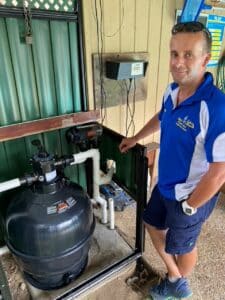
Many pool owners run into the same issues when they rely on horsepower rather than pump performance.
A correctly sized pump should work efficiently, not aggressively. The goal is balanced circulation, not brute force.
When a Jim’s Pool Care technician sizes a pump, they take a full view of your pool system. They will look at:
This approach ensures the pump does exactly what your pool needs without wasting power or pushing the system too hard.
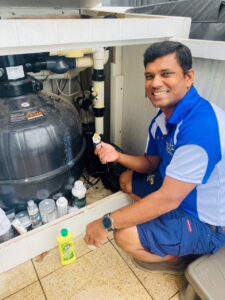
Variable speed pumps have quickly become the preferred option for most pools. Their benefits include:
It’s common to see a smaller horsepower variable speed pump outperform a much larger single-speed pump because of better efficiency and smarter control.
Horsepower is only one small piece of the puzzle. What really matters is the pump’s actual flow at the head pressure of your pool system. That’s why pump curves, flow requirements, and plumbing layout are the foundations of proper pump sizing.
A correctly sized pump will give you better filtration, lower running costs, quieter operation, and a healthier pool overall.
If you need to replace your pool pump, your local Jim’s Pool Care technician can assess your pool system and recommend the right fit.
Get to know our studio before you commit to becoming a regular student. We can’t wait to meet you!